Denver Water Heater Repair, Replacement & Installation
We specialize exclusively in water heaters, including tank, tankless, gas, electric, and heat pump systems. Whether you need repair, replacement, installation, maintenance, or emergency service, our technicians diagnose the problem honestly and recommend the right solution for your home.
- Prompt scheduling
- Licensed & insured
- Water heaters only
- Upfront pricing
- Master plumber
- 4.9★ homeowner rating
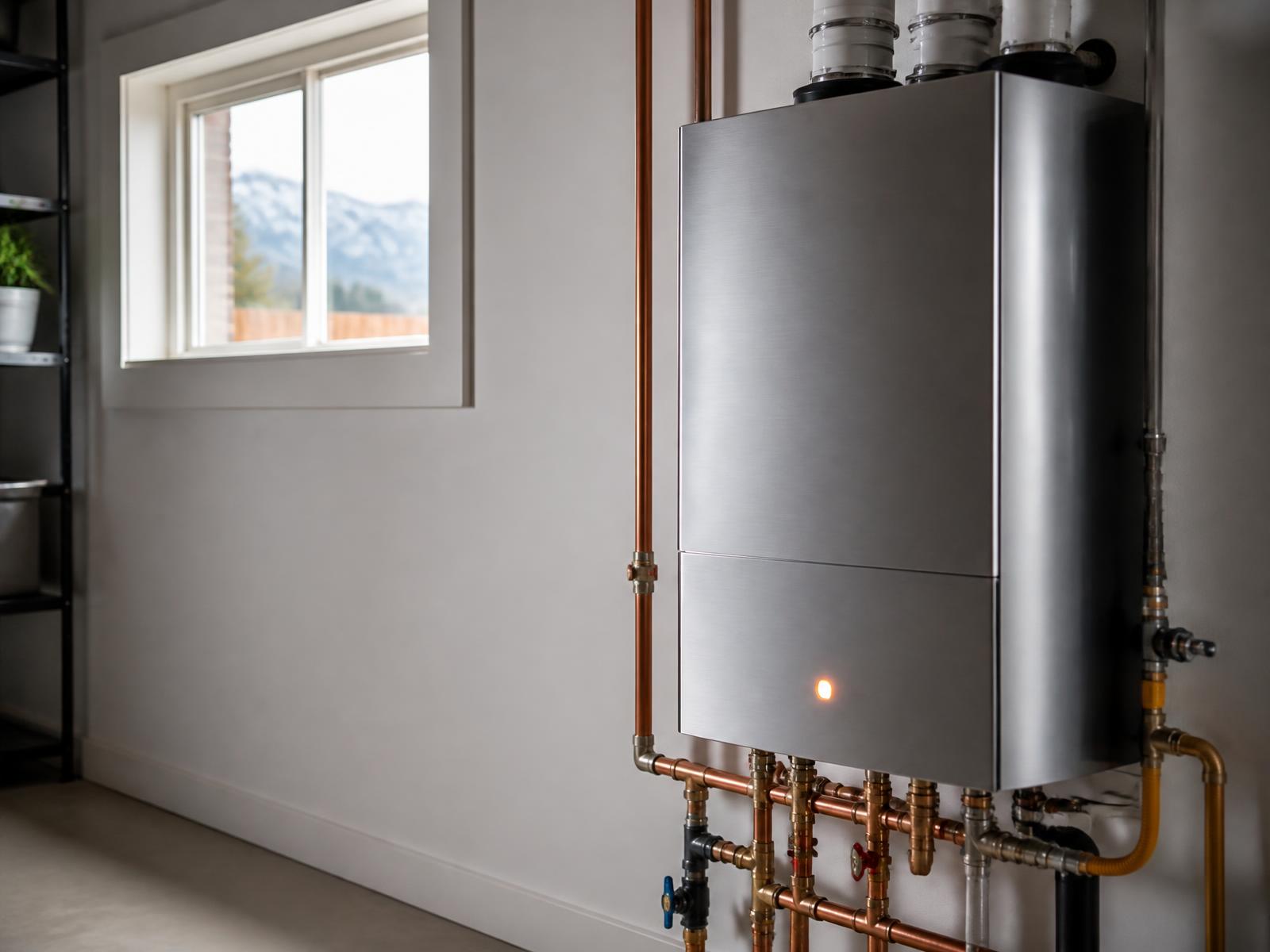
“They walked me through repair vs. replace honestly. New 50-gallon installed the same afternoon — no upsell.”
— Jenna R., Wash Park
Water heater repair, diagnosed by specialists
A hot water problem is rarely one thing. It is a chain of components — burner or element, thermostat, thermocouple, dip tube, anode, gas valve, TPR valve — that each fail differently. Our technicians diagnose that chain in one visit.
Read the complete water heater repair guide →
Most repair calls we take across the metro fall into one of a handful of categories: the burner or heating elements are worn, the thermostat is out of calibration, the pilot assembly has failed, sediment has caked over the bottom of the tank, or the unit is simply at the end of its service life. The right call depends on the age of the tank, the failure mode, and whether the repair extends the life of the heater or simply postpones a replacement by six months.
We show up in a fully stocked truck. Common parts — elements, thermostats, thermocouples, gas control valves, TPR valves, dip tubes, sacrificial anode rods, flex connectors, expansion tanks — are on board. That means most repairable failures are fixed the same visit, without a return trip and a second service fee.
What we repair, every week
- Heating element replacement (electric)
- Upper & lower thermostat swap
- Thermocouple / flame sensor
- Gas control valve replacement
- Pilot assembly & igniter
- TPR (safety) valve replacement
- Sediment flush & tank clean-out
- Anode rod replacement
- Dip tube replacement
- Expansion tank install
- Leaking supply / flex connector
- Tankless error-code diagnosis
- Tankless heat-exchanger descaling
- Recirculation pump repair
When repair is the right call
Repair is almost always the right answer when the heater is under eight years old, the tank itself is dry and intact, and the failure is a discrete component. A ten-year-old tank with a weeping seam is a different conversation — see the repair vs. replacement guide further down.
Pro tip: age the tank before you spend a dollar
Safety warning: TPR valves are not decorative
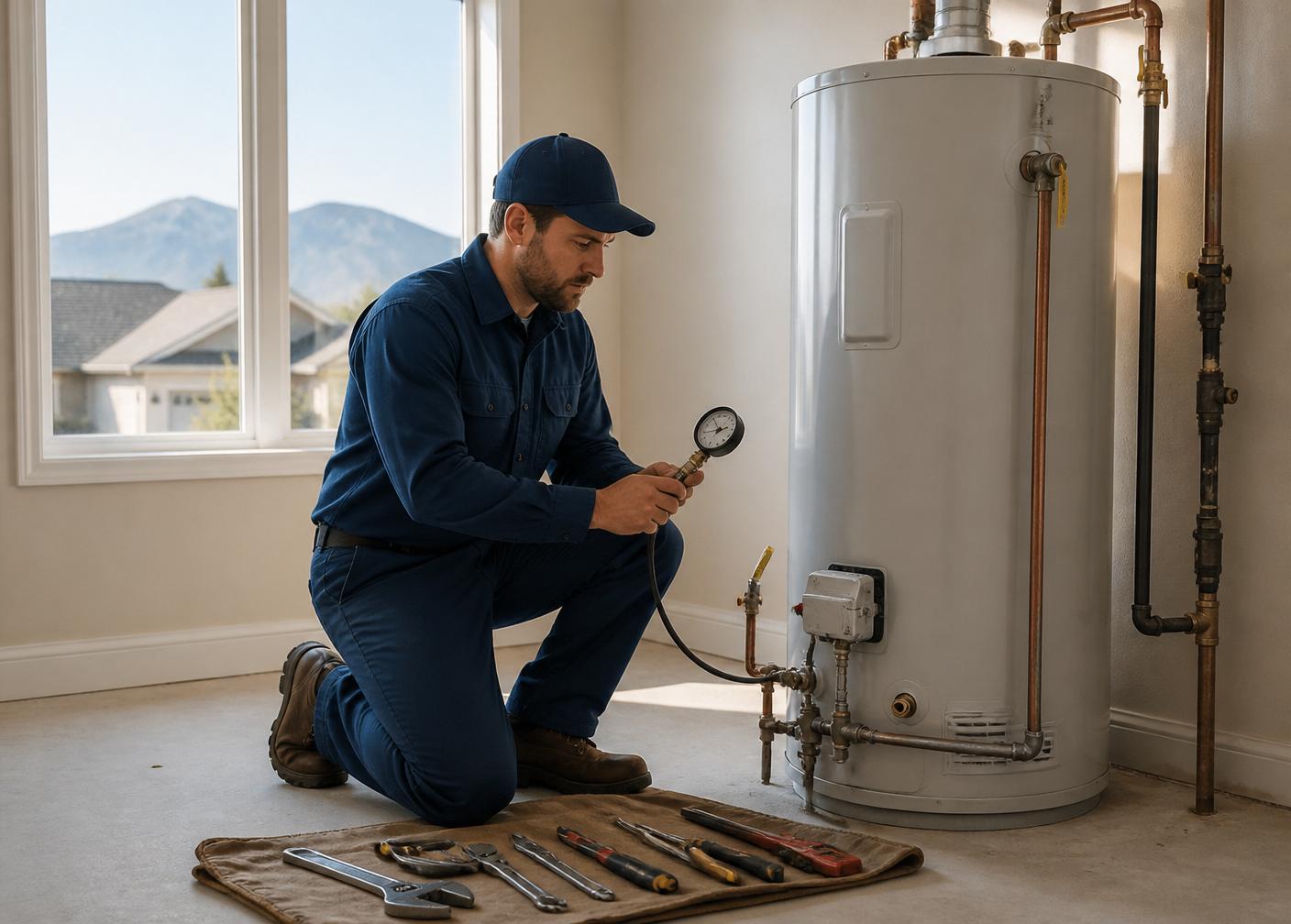
- Typically quick · Element, thermostat, thermocouple, pilot, TPR, flex
- 1–2 days · Gas valve, tankless control board, recirc pump
- 3–5 days · Warranty-covered heat exchanger swap
Water heater replacement done right
A replacement is not just swapping a tank. It is sizing correctly for the household, updating the connections to current local code, sealing the venting properly and disposing of the old unit — with a permit pulled and a final inspection scheduled.
Read the complete water heater replacement guide →
The most expensive water heater is the one that's been sized wrong. A three-bathroom household on a 40-gallon tank will chase hot water forever; a two-person condo with an 80-gallon tank will pay to heat water it never uses. We size to first-hour demand, not a rule of thumb.
What a proper replacement includes
- Load-based sizing (first-hour rating + peak demand)
- Code-compliant venting: B-vent, direct-vent or power-vent
- New water shut-off, flex connectors, dielectric unions
- Expansion tank sized to house PSI
- New TPR valve and discharge tube to code
- Seismic strapping and drip pan where required
- Combustion air check on gas units
- Altitude derating verified on gas burners
- Local municipal permit pulled and inspection scheduled
- Old unit hauled and recycled at no extra charge
Local code, plainly stated
What to expect
- 0:00Arrival & isolationWater and gas or power isolated, tank drained through a fitted hose to the nearest drain.
- 0:45RemovalOld unit disconnected, capped, wheeled out on a dolly, loaded for recycling.
- 1:15PrepNew shut-off, expansion tank, flex connectors, drip pan and any needed venting adjustments installed.
- 2:00Set & connectNew heater set, plumbed, gas- or power-connected, TPR discharge run to code, seismic strapping installed.
- 2:45Fill & fireTank filled, air bled, unit fired or energized, combustion checked, no-leak test held at pressure.
- 3:30WalkthroughYou get the manual, the serial number for warranty registration, and a plain-English rundown of what changed.
Water heater installation — done to code
New construction, whole-house remodels, ADUs and finished basements. We work directly with homeowners, general contractors and design-build firms throughout our service area.
New construction
Ground-up single-family and townhome projects. We coordinate with your GC on rough-in, gas sizing, and inspection timing.
Remodels & finished basements
Relocating the heater? Adding a bathroom? We handle venting reroutes, gas resizing and permitting so your remodel passes on the first walk.
ADUs & carriage houses
Metro-area ADUs frequently need dedicated water heating. We spec compact tank, tankless, or heat-pump units sized for the actual load.
Every install includes, without exception
- Load-based sizing (first-hour or GPM)
- Correct venting: B-vent, direct-vent or power-vent
- New shut-off, flex connectors, dielectric unions
- Expansion tank sized to house PSI
- New TPR valve, discharge to code
- Seismic strapping and drip pan where required
- Combustion air verification on gas units
- High-altitude derating on gas burners
- Local municipal permit + final inspection
- Old unit hauled and recycled
- Warranty registered in your name
- Written scope, plain-English walkthrough
Warrantied in writing
From estimate to hot water
- Step 1Site visit & load sizingWe measure first-hour demand, gas or electrical capacity, venting path and clearances — not a phone-quote guess.
- Step 2Written estimateLine-item scope with equipment, code items, permit and disposal. No verbal upsells on install day.
- Step 3Permit pulledWe file the municipal permit in your address so the inspection record follows the property.
- Step 4Install dayOld unit removed, new unit set, plumbed, vented, gas- or power-connected, tested at pressure.
- Step 5Final inspectionWe coordinate the municipal inspection and stay engaged until the permit is closed and signed off.
- Step 6Walkthrough & warrantyYou get the manual, serial numbers, warranty registration and a first-year maintenance reminder.
Installation questions homeowners ask us
Do you pull the permit, or do I?
We pull it, we file it under your address, and we stay on the job until the municipal inspector signs it off. The record follows the home at resale.
How long does a typical install take?
A like-for-like tank replacement is usually a single-visit job. A tankless conversion or a relocation with new venting and gas resizing is typically a longer install and may span a second visit for inspection.
Can you install the unit I already bought?
We can, but we'll walk you through the tradeoffs first — warranty registration, sizing, venting fit, and altitude derating. Most homeowners let us supply the unit so a single warranty covers parts and labor together.
Do you handle gas line or electrical upgrades?
Yes. Tankless conversions and heat-pump installs often need gas resizing, a dedicated circuit or a condensate drain. Those are quoted line-item on the written estimate before install day — no surprises.
Experienced water heater specialists focused on honest recommendations, quality workmanship, and dependable repairs, replacements, and installations for every home.
No hot water? Tank leaking? We're on the way.
A failing water heater doesn't wait for business hours. Neither do we. Call the emergency line and a licensed technician will respond as quickly as scheduling allows — priority appointments for urgent no-hot-water and active-leak situations.
- No hot water anywhere in the house
- Water pooling around the tank
- Pilot light won't stay lit
- Loud banging or rumbling from the tank
- Gas smell near the heater
- Pressure relief valve dripping
- Rusty or brown hot water
- Water heater completely burst
Residential water heater work — and only that.
Because every technician on our team works on the same equipment every day, we install and repair faster, catch problems your general plumber will miss, and stand behind the workmanship in writing.
Water Heater Repair
Element and thermostat replacement, thermocouple, pilot, gas valve, TPR valve, sediment flushing, sensor faults and control board diagnostics.
Learn more about water heater repairWater Heater Replacement
Right-sized like-for-like replacements and full upgrades — including permit, code updates, disposal of the old unit and start-to-finish testing.
Learn more about water heater replacementNew Installation
New construction, remodel, ADU and finished-basement installs. Proper venting, expansion tank, seismic strapping, gas sizing and permit pulled every time.
Learn more about new installationTankless Conversions
Tank-to-tankless upgrades done correctly — gas line resizing, condensate handling, venting and a warranty-registered install.
Learn more about tankless conversionsGas Water Heaters
Natural gas and propane units, atmospheric and power-vent. We handle combustion air, draft, and altitude-specific burner derating.
Learn more about gas water heatersElectric Water Heaters
Standard resistance and heat pump water heaters. Correct breaker sizing, wire gauge, condensate drain and heat-pump placement.
Learn more about electric water heatersEmergency Service Available
Burst tanks, no hot water, leaks and gas odors. Live phone coverage after hours — no answering service, no voicemail runaround.
Learn more about emergency service availableMaintenance & Anodes
Annual flush, anode rod inspection, TPR test, tankless descaling. Local water conditions are tough on heaters — a yearly service pays back.
Learn more about maintenance & anodesTank or tankless? Both are right — for different homes.
There is no universally better water heater. There is one that fits your household's hot water pattern, your gas or electrical service, and the space you have to install it in. Here is how we help homeowners decide.
Read the complete tankless water heater guide →
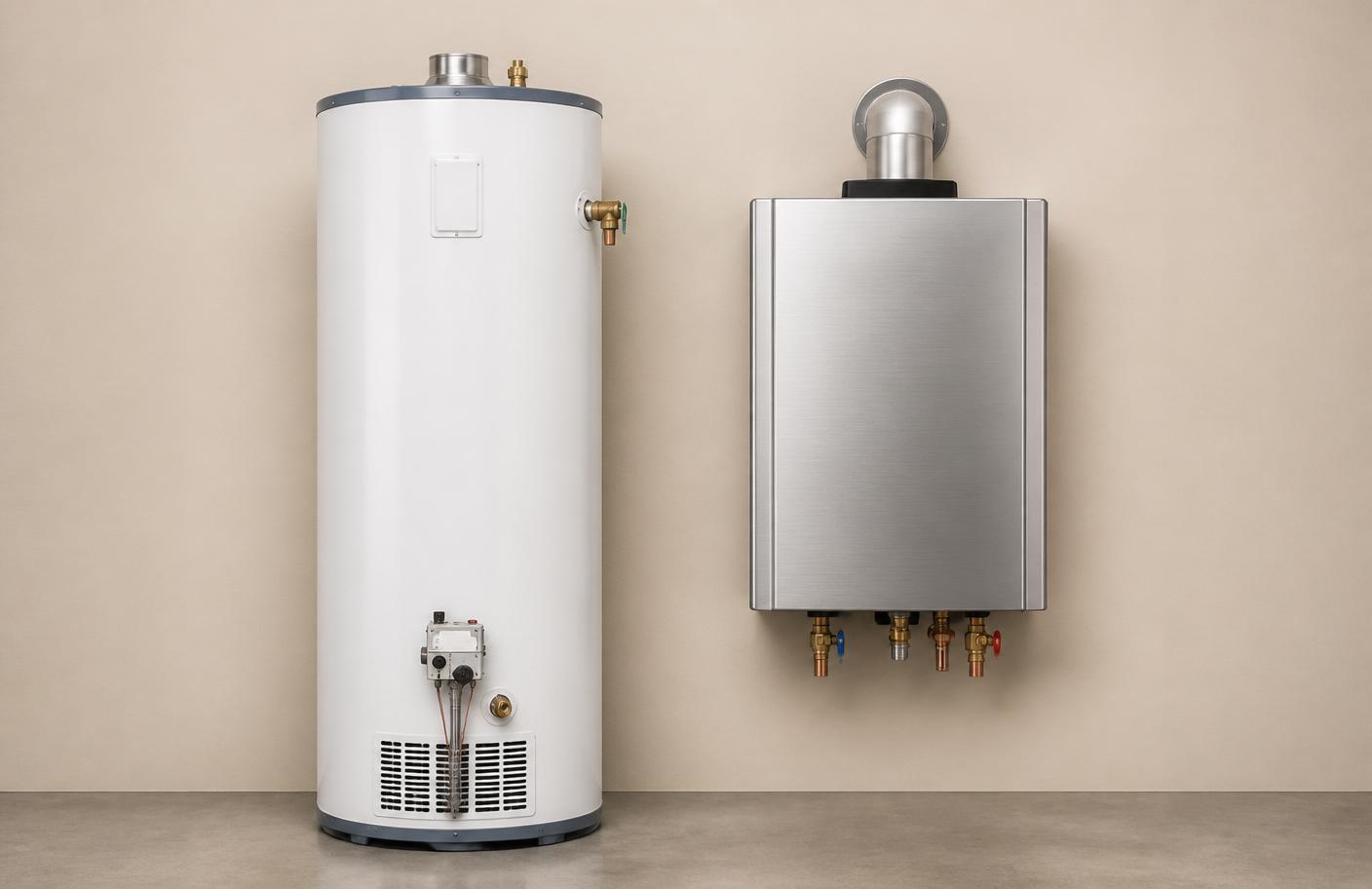
| Consideration | Tank | Tankless |
|---|---|---|
| Upfront cost (installed) | $1,800 – $3,400 | $4,200 – $7,500 |
| Expected lifespan | 10 – 13 years | 18 – 22 years |
| Space required | Floor: 24″×60″ | Wall: 20″×30″ |
| Simultaneous demand | Limited by tank size | Limited by BTU / GPM |
| Recovery after heavy use | 45 – 60 minutes | Continuous |
| Hard-water maintenance | Annual flush | Annual descale |
| Best for | 1–4 person households, tight budgets | Large households, remodels, long-term owners |
Tankless installation, repair, and annual descaling
On-demand water heaters reward correct installation and punish neglected maintenance. Here is how we handle each phase of tankless ownership — from a first-time conversion to a decade-old unit throwing an error code.
Tankless installation
Wall mounting, gas-line resizing (often ¾″ upgraded to 1″), stainless or PVC venting, condensate neutralizer, isolation valves, and warranty registration. Sized to peak GPM at the coldest inlet temperature of the year — not a marketing brochure.
Tankless repair
Flame-rod cleaning, ignition and flow-sensor diagnostics, control-board swaps, gas-valve service and error-code triage across Rinnai, Navien, Noritz, Rheem and Bosch. Most repairs are completed in a single visit with parts on the truck.
Tankless maintenance, flush & descaling
An annual descale with a food-safe solution pulls calcium off the copper heat exchanger, restores GPM to spec, and extends unit life by 30–40%. Hard water throughout the region makes this non-optional, not a nice-to-have.
Sizing a tankless by GPM, not gallons
Skipping the annual descale voids warranty
Gas or electric — an altitude-specific answer
Colorado natural gas rates make gas an efficient default for larger households. But new heat-pump electric water heaters are changing the math in tightly sealed homes and rebate-eligible neighborhoods.
Gas water heaters
Natural gas heats water quickly and stays inexpensive per BTU compared to grid electricity in Colorado. The trade-offs are venting complexity and combustion air. At our altitude (5,280 ft+), burners are derated roughly 4% per 1,000 ft above sea level — an install detail your general plumber may not adjust for, but we always do.
- Fast recovery — good for high-demand households
- Lower cost per gallon heated at current CO gas rates
- Requires venting: B-vent, direct-vent or power-vent
- Needs combustion air and proper draft
- Altitude derating verified on every install
Electric & heat-pump
Standard electric resistance heaters are simple and reliable. Heat pump water heaters (HPWH) are dramatically more efficient — 3× to 4× the delivered heat per unit of electricity — and qualify for federal, Xcel Energy and Colorado state rebates that can offset most of the upgrade cost. HPWH need conditioned space and drainage.
- No combustion air, no venting required
- Heat-pump models: 3–4× the efficiency of resistance
- Rebate-eligible under IRA and Xcel programs
- Need proper breaker & wire sizing
- HPWH require condensate drain and airflow
Every failure has a cause. We find it in one visit.
Below are the most common calls we take across the metro. Read through — if you recognize your symptoms, chances are we carry the parts to address it on the visit.
No hot water at all
Usually a failed thermocouple, gas control valve or tripped high-limit switch on gas units; a burned-out element or reset breaker on electric.
Puddle around the tank
Could be a dripping TPR valve, a corroded drain valve, a loose supply flex — or a leaking tank seam, which is not repairable.
Water not hot enough
Thermostat drift, dip tube failure, sediment buildup, or an undersized tank for the household's actual use pattern.
Rusty or discolored hot water
The sacrificial anode rod has been consumed and the tank is starting to corrode from the inside. Test the anode annually.
Loud banging or rumbling
Almost always mineral scale settling on the burner surface. A proper flush usually fixes it. On old tanks it may indicate a failing bottom.
Pilot won't stay lit
Thermocouple, thermopile or a dirty pilot orifice — usually a same-visit repair on modern gas units.
Breaker keeps tripping
Failed element with a short to ground, a bad thermostat, or an undersized breaker from a prior install.
Tankless error code
We diagnose ignition, flame-rod, over-temp and flow-sensor codes across Rinnai, Navien, Rheem, Noritz and Bosch units.
Repair or replace? Use the 50/10 rule.
A quick, honest framework we walk homeowners through on every diagnostic call. It removes the emotion and it removes the upsell.
The 50/10 rule
What we will not do
Not sure which side of the line you're on?
Text or call with the make, model and age of your unit and we'll give you an honest read before we roll a truck.
Water heater types and sizes, matched to your household
Choosing between a 40, 50, 75, or 80-gallon tank — or skipping tanks entirely — comes down to first-hour demand, fuel type available, and how the space is laid out. A quick primer on the options we install every week.
Storage tank water heaters
The classic 40–80 gallon insulated tank, gas-fired or electric. Lowest upfront cost, simplest install, and easiest to replace like-for-like. Best for households whose hot-water use is predictable and clustered (morning showers, evening dishes).
Tankless (on-demand) water heaters
Wall-mounted units that heat water only as it flows. Higher upfront cost, much longer lifespan, unlimited continuous hot water sized to BTU and GPM. Ideal for larger households, long-term owners, and remodels reclaiming floor space.
Heat pump (hybrid) water heaters
Electric units that pull ambient heat from the surrounding air — 3–4× the delivered efficiency of resistance. Best in conditioned basements with a floor drain and rebate-eligible utility service.
Point-of-use & solar-assisted
Small under-sink electric units for detached ADUs, workshop sinks, or long plumbing runs. Solar-thermal preheat loops are still viable in Colorado for the right roof orientation.
Which size is right?
| Household | Tank size | Tankless BTU |
|---|---|---|
| 1–2 people, 1 bath | 30–40 gallon | 140,000 BTU |
| 2–3 people, 1.5 bath | 40 gallon | 160,000 BTU |
| 3–4 people, 2 bath | 50 gallon | 180,000 BTU |
| 4–5 people, 2.5 bath | 50–75 gallon | 199,000 BTU |
| 5+ people, 3+ bath | 75–80 gallon or dual tankless | 2× 180,000 BTU |
What water heater work actually costs in our area
Real installed prices — not equipment-only, not stripped-down. Numbers include the unit, permit, labor, and all standard code updates. Older homes with extensive venting or gas-line work run to the higher end.
| Unit type | Installed price | Typical lifespan | Best fit |
|---|---|---|---|
| 40-gal atmospheric gas | $1,850 – $2,600 | 10–12 years | Standard 3-bed household |
| 50-gal atmospheric gas | $2,100 – $2,900 | 10–12 years | 3–4 bed with 2 baths |
| 50-gal power-vent gas | $2,900 – $3,900 | 10–12 years | Utility closet / no chimney |
| 50-gal electric (resistance) | $1,700 – $2,400 | 10–13 years | No gas / townhome |
| 50-gal heat-pump electric | $3,400 – $4,800* | 13–15 years | Rebate-eligible upgrades |
| Tankless gas (interior) | $4,200 – $5,900 | 18–22 years | Space-constrained / high demand |
| Tankless gas (exterior) | $4,600 – $6,400 | 15–20 years | Colorado climate: freeze protection required |
| Tank-to-tankless conversion | $5,800 – $7,500 | 18–22 years | Gas resize + venting + condensate |
* Heat-pump price shown before Inflation Reduction Act, Xcel Energy and Colorado Energy Office rebates, which frequently cover $1,500–$2,600 of the installed cost.
Water heater replacement cost
A straight like-for-like tank replacement runs $1,850–$2,900 installed for a standard 40 or 50-gallon gas unit — permit, expansion tank, code updates, disposal and warranty registration included. Power-vent, direct-vent and tankless conversions add $1,000–$3,500 depending on venting and gas-line work.
Water heater installation cost
A new installation (no existing unit — new construction, ADU, relocated closet) starts around $2,400 and scales with rough-in work. A first-time tankless install with fresh venting and a resized gas line typically lands between $4,600 and $7,500.
We install and service every major residential brand
Our technicians carry manufacturer-authorized training for the brands below, which matters two ways: warranties stay valid, and we know each unit's failure patterns before we open the panel.
Municipal water here is hard on water heaters. A yearly service pays back.
Municipal water throughout the metro sits between 60 and 200 ppm hardness depending on the neighborhood. That mineral load settles inside your tank as sediment or scales the heat exchanger of a tankless unit. An hour a year keeps efficiency up and extends the heater's life 30–40%.
Read the complete maintenance guide →
Annual flush
We drain the sediment from the bottom of your tank, inspect the drain valve and refill and vent the unit properly.
Anode rod check
The sacrificial anode is the only thing between hard water and your tank steel. We measure the remaining rod and swap it before it's consumed.
TPR & expansion test
We test the safety valve, verify the expansion tank pressure and confirm the house PSI is inside spec — the leading cause of premature tank failure.
Tankless descaling
Every tankless heater in our service area needs an annual descale. We isolate the unit, circulate a food-safe solution and restore flow to spec.
Combustion check
On gas units we verify draft, flame appearance, gas pressure and confirm the altitude derating is still correct after any Xcel meter changes.
Element & thermostat test
On electric units we meter both elements, verify both thermostats and confirm no ground faults are developing on aging wiring.
Recommended water heater maintenance schedule
A predictable cadence keeps efficiency up, prevents premature tank failure, and preserves the manufacturer's warranty. Print this schedule and stick it inside the utility-room door.
| Interval | Tank (gas or electric) | Tankless | Heat pump |
|---|---|---|---|
| Every 6 months | Visual leak check, TPR lever test | Check inlet filter screen | Wipe evaporator coil, clear air intake |
| Annually | Full sediment flush, anode inspection, expansion tank PSI check | Descale heat exchanger, flush isolation valves, clean burner | Full flush, anode inspection, condensate drain flush |
| Every 3–5 years | Anode rod replacement (sooner on softened water) | Replace inlet filter, inspect flame rod & igniter | Anode rod replacement, refrigerant sensor check |
| Every 8–10 years | Plan replacement budget; recheck warranty status | Replace flow sensor / igniter as needed | Compressor & fan performance test |
Water heater lifespan by unit type
How long a water heater lasts depends on fuel type, water chemistry, and whether it has been maintained. These are the realistic service lives we see on units across the region — well-maintained on the upper end, neglected on the lower.
- Atmospheric gas tank10–13 years
- Power-vent gas tank10–12 years
- Electric resistance tank10–15 years
- Heat pump (hybrid) water heater13–15 years
- Tankless gas (condensing)18–22 years
- Tankless gas (non-condensing)15–20 years
Six reasons area homeowners keep our number in their phone
We only work on water heaters
One trade. Every technician runs 12+ water heater calls a week. That focus is why we install faster and diagnose more accurately than a general plumbing outfit.
Upfront, flat-rate pricing
You approve the total before we touch a wrench. No hourly meter, no surprise line items, no commissioned salespeople.
We understand local homes
Altitude derating, hard water, expansion tanks on closed systems, 100-year-old Baker bungalows and slab-on-grade suburbs. We know your house.
Repair-first honesty
If the honest answer is a $180 repair, that's the recommendation you get — even when a replacement would be an easier sale.
Warrantied in writing
2-year workmanship warranty on every install, on top of the manufacturer coverage. If something we did fails, we fix it — no argument.
Answered — day, night, weekend
A live person, not a call center. After-hours emergencies get a real technician callback as promptly as scheduling allows.
What local homeowners say
Every review below is from a real, verifiable service call. We pull our public ratings from Google, Nextdoor and the Better Business Bureau.
Called at 6 a.m. with no hot water. Tech was on-site by 8:15, diagnosed a bad gas control valve, had one on the truck, and I was showering by lunch. Priced exactly what was quoted.
We did a tank-to-tankless conversion. They handled the gas resize, venting through the rim joist, and the permit. Passed inspection first try. The office kept us updated the entire time.
Our 12-year-old heater started weeping around the base on a Sunday. They didn't try to sell us anything on the phone — walked us through shutting off the water and had a new 50 gallon installed Monday morning.
Third company we called for a tankless error code. First two wanted to replace the whole unit. Their tech diagnosed the flame rod in fifteen minutes and cleaned it. $220 instead of $6,000. That is why they earned every future call.
Installed a heat pump water heater and walked us through the Xcel rebate paperwork. Total out of pocket was under what a standard replacement would have been. Very professional crew.
Annual maintenance visit. They flushed the tank, replaced the anode rod, and showed me the expansion tank was shot. Fixed it on the spot. Not pushy about anything, just useful.
Serving the entire Denver metro
If you're inside the C-470 loop or one of the surrounding foothill and southern communities, we cover you. Not on the list? Call — we probably still service your ZIP code.
Local details that matter
- Altitude: Denver's 5,280 ft base elevation requires gas-burner derating on every install — non-negotiable.
- Hard water: Municipal water here averages 100–200 ppm. Plan on annual flushing of tanks and descaling of tankless.
- Permits: Denver, Aurora, Jefferson County, Arapahoe County and Douglas County all require a permit for water heater replacement. We pull it, every time.
- Rebates: Xcel Energy and the Colorado Energy Office offer significant rebates on heat pump water heaters. We complete the paperwork with you.
Water heater permits, code requirements, and Colorado rebates
A code-legal installation protects your homeowner's insurance, your warranty, and the resale value of the house. It also unlocks utility and federal rebates that can offset thousands off a heat-pump or high-efficiency install.
Water heater permits
Denver, Aurora, Jefferson County, Arapahoe County, Douglas County, Broomfield and Boulder County all require a mechanical or plumbing permit for a water heater replacement. We pull the permit under our license, schedule the inspection, and hand you the closed-out paperwork.
Code requirements
- • Expansion tank on any closed system with a PRV or backflow
- • Sediment trap and appliance shutoff on the gas line
- • Full-port cold-side shutoff within reach of the unit
- • TPR discharge run to within 6″ of the floor or a drain
- • Seismic strapping in garages and living spaces
- • 18″ ignition height on gas units in garages (unless FVIR)
- • Drip pan piped to drain on any unit above finished space
Rebates & tax credits
- • Federal 25C tax credit: up to $2,000 on heat-pump water heaters
- • Xcel Energy rebates: $500–$1,000 on qualifying HPWH installs
- • Colorado Energy Office HEEHRA: income-scaled up to $1,750
- • Utility rebates for high-efficiency tankless (0.90+ UEF)
- • Local water utility rebates for smart leak sensors
We complete the rebate paperwork with you at the time of install.
Water heater questions area homeowners actually ask
Grouped by what you're likely trying to figure out. Nothing here is padded — every answer is what we'd tell a neighbor.
Cost & timing
Repair vs. replace
Equipment choices
Emergencies & safety
About the service
Talk to a real Denver water heater specialist — right now.
Call to schedule a visit, request a written estimate, or just get a plain-English second opinion on a quote you've already received. No pressure, no upsell.